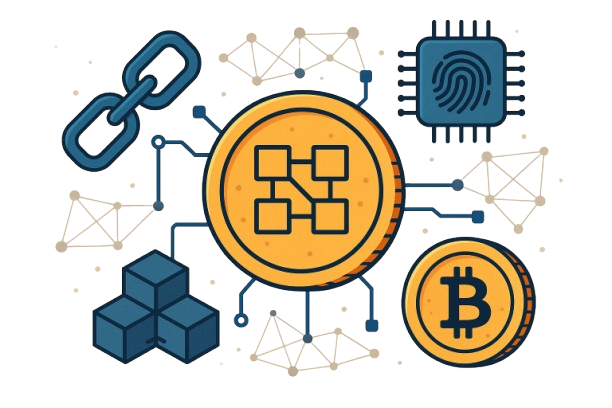

Imagine This:
You want to send money to a friend in another country. Usually, this involves banks, fees, waiting, and a lot of trust in the middlemen.
Now, imagine doing the same thing instantly, securely, and without a bank—and both sides can verify the transaction without knowing each other.
This is the magic of blockchain—a revolutionary technology that’s changing how we store, share, and trust information.
What Is Blockchain?
At its core, blockchain is a digital ledger—a list of records—spread across a network of computers. But what makes it special is:
- Decentralization: No single person or company owns it.
- Blocks: Data is stored in blocks, like pages in a notebook.
- Chaining: Each block is linked to the previous one, forming a chain.
- Permanent: Once added, data can’t be changed or deleted without detection.
So, blockchain is basically a secure, shared, and tamper-proof database.
How It Works (Simplified)
- A transaction or piece of data is created.
- It’s sent to a network of computers (called nodes).
- The computers verify the data using complex math.
- Once verified, the transaction is added to a block.
- That block is added to the chain.
- Now it’s stored across thousands of computers—publicly visible and permanent.
It’s like writing in a notebook that everyone owns a copy of, and no one can erase.
Blockchain and Bitcoin: What’s the Connection?
You’ve probably heard of Bitcoin—the first cryptocurrency.
Bitcoin was the first real use of blockchain back in 2009.
Bitcoin uses blockchain to:
- Record who owns how much
- Prevent double-spending
- Replace banks with a peer-to-peer system
But blockchain isn’t just about crypto. It has far bigger uses.
Where Is Blockchain Being Used?
1. Finance
- Instant, secure money transfers
- Crypto trading (e.g., Ethereum, Solana)
- Decentralized finance (DeFi) platforms
2. Supply Chain
- Track food, medicine, or electronics from factory to store
- Ensure no one fakes or tampers with products
3. Healthcare
- Secure patient records
- Share medical history without risking privacy
4. Voting
- Blockchain-based voting could reduce fraud and increase trust in elections.
5. Smart Contracts
- Digital agreements that run themselves when conditions are met (like auto-payment when work is done)
Key Benefits of Blockchain
| Feature | Why It Matters |
|---|---|
| Security | Data is encrypted and almost impossible to hack |
| Transparency | Anyone can verify the data in the chain |
| No middlemen | Peer-to-peer system reduces cost and time |
| Immutability | Once data is in the chain, it can’t be changed |
Challenges and Limitations
- Scalability: Can be slow with many users
- Energy Use: Some blockchains (like Bitcoin) use lots of electricity
- Regulation: Governments are still figuring out how to control it
- Complexity: It’s new and still evolving—people need time to understand it
The Future of Blockchain
We’re just scratching the surface. In the next few years, blockchain could:
- Power your digital identity
- Replace traditional banks with fully decentralized systems
- Run secure internet infrastructure
- Help build the metaverse and Web3
As blockchain grows, so does the power to trust systems, not middlemen.
Final Thoughts
Blockchain isn’t just about money or Bitcoin—it’s a whole new way of thinking about data, trust, and control.
Whether you’re a business owner, developer, or just a curious tech lover, blockchain is something worth understanding today, because it’s shaping the way we live tomorrow.